Step-by-Step Tutorial: How to Weather-Seal & Insulate Windows and Doors against Calima Dust, Wind and Noise in Tenerife
Discover how to block fine Saharan calima dust, drafts and coastal wind by fitting high-elasticity silicone weatherstripping, mohair brush seals on sliding tracks and UV-proof perimeter sealants.
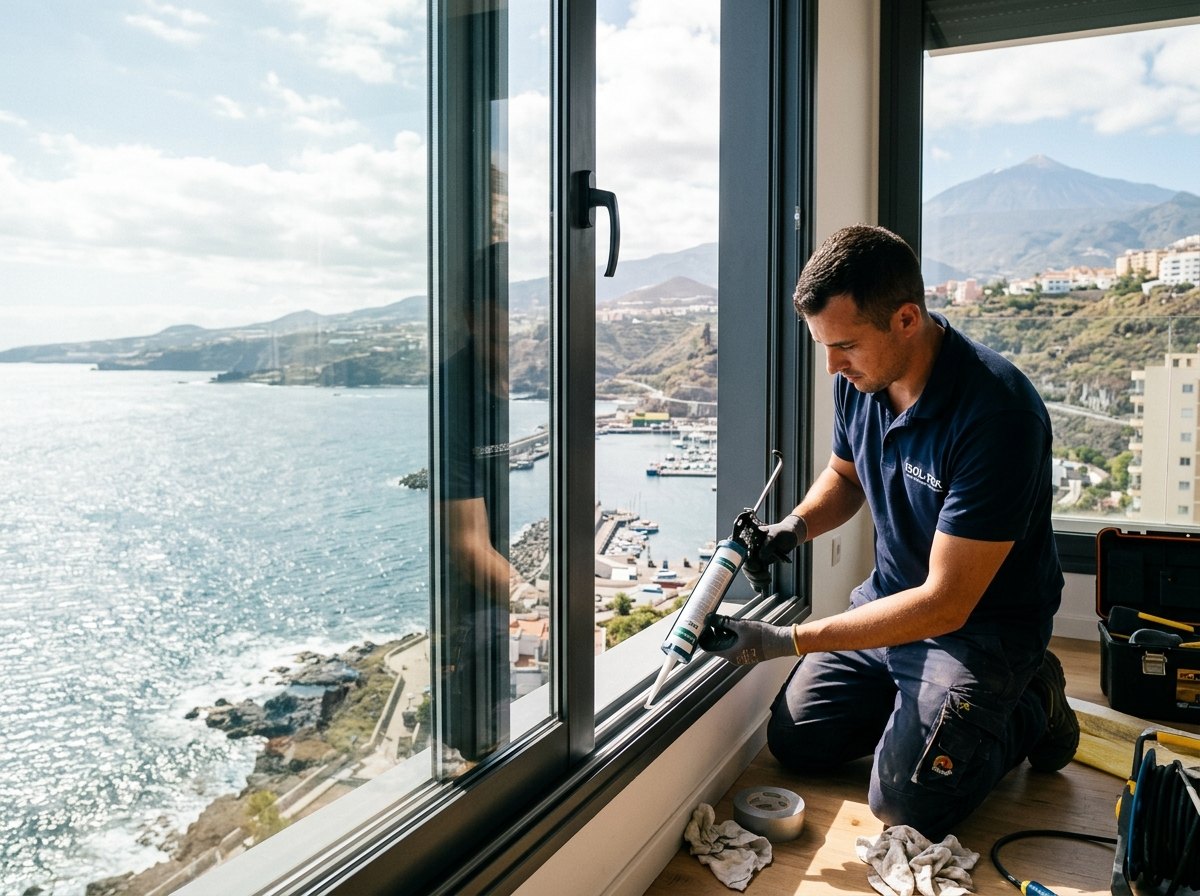
Informational Notice: This tutorial and its instructions are provided strictly for general educational and informational purposes. They do not constitute binding technical advice or formal engineering recommendations. If you lack prior experience or tools, we advise contacting a certified Handyman Tenerife professional.
Before You Begin: Safety Protocol
- 1. Paper test: close the window on a sheet of paper; if you can pull it out easily, that area has an air leak needing sealing.
- 2. Identify window type: sliding windows need mohair brush pile, while casement/tilt windows need tubular silicone.
- 3. Strip old brittle weatherstrip and degrease surface completely with alcohol.
📦 Materials Required
- ✓ Tubular silicone weatherstrip with D, P, or E profile (for 2mm to 7mm gaps)
- ✓ Self-adhesive mohair brush pile weatherstripping for sliding window sash tracks
- ✓ UV-resistant MS Polymer elastomeric sealant cartridge for external frame gaps
- ✓ Automatic drop-down door sweep or aluminum brush draft excluder for entrance door
- ✓ Isopropyl alcohol and lint-free cleaning wipes
🛠️ Recommended Tools
- 🔧 Sharp scissors or utility knife for 45° miter cuts
- 🔧 Caulking gun for sealant application
- 🔧 Tape measure and gap gauge (or modeling clay) to measure clearance
- 🔧 Screwdriver for latch and window strike adjustment
📋 Step-by-Step Project Guide
Step 1: Gap clearance measurement & profile selection
Measure the gap between window sash and frame. Use E-profile for 1-3mm gaps, P-profile for 3-5mm gaps, and D-profile tubular silicone for 4-7mm gaps.
Place a small ball of modeling clay on the frame and close the window: the flattened thickness reveals the exact gap size needed.
Step 2: Surface cleaning and degreasing
Scrape off brittle old seals with a plastic scraper. Wipe the aluminum rebate with isopropyl alcohol to remove all grime and Saharan calima dust.
Never use mineral spirits or greasy solvents; they leave a residue that degrades adhesive bonding.
Step 3: Fitting silicone weatherstripping on casement windows
Start from a top corner. Peel the backing paper gradually and press firmly without stretching the rubber strip (stretching causes shrinkage over time). Cut 45° miters at corners for continuous sealing.
Apply firm thumb pressure along the entire strip to fully activate the acrylic adhesive bond.
Step 4: Renewing mohair brush pile on sliding windows
On sliding windows, dust enters through center meeting stiles and top/bottom tracks. Apply high-density mohair brush seals along the interlock profile to stop wind drafts while maintaining effortless sliding action.
Tune the window latch catch screws to increase closing compression against the frame.
Step 5: External perimeter frame caulking & door sweep installation
Check the outer perimeter joint between window frame and masonry wall. Seal hairline cracks with UV-resistant MS Polymer sealant. On the front entrance door, install an automatic drop-down door bottom seal.
Automatic door sweeps lift when opening to prevent floor drag and drop down firmly when the door closes, sealing out drafts.
📊 Technical Specifications Sheet
| Dust/calima reduction | Up to 85% less airborne fine dust inside |
|---|---|
| Energy saving on AC | 20% to 30% reduction on cooling and heating costs |
| Acoustic attenuation | Attenuation of up to 6 to 10 dB in wind/traffic noise |
| Silicone seal lifespan | 8 to 10 years (UV and coastal salt resistant) |
🧱 Wall Anchor Selection Guide for Tenerife
Sliding / casement aluminum or PVC window frame
Recommended Plug: High-bond acrylic adhesive backing or channel-slide insertion
💡 Thoroughly degrease aluminum surface with isopropyl alcohol to ensure strong adhesive bonding.
🧹 Maintenance & Aftercare Tips
- Wipe silicone seals with a damp sponge every 6 months to remove accumulated Saharan dust.
- Vacuum sliding window tracks after calima weather events to keep brush piles soft and effective.
- Check window lock tightness once a year.
- Replace weatherstripping if rubber loses rebound elasticity or shows sun checking.
❓ Frequently Asked Installation Questions
Q: How can I prevent Saharan calima dust from entering through windows?
A: By fitting tubular silicone seals on casement windows, dense mohair brush pile on sliding tracks, and sealing external frame perimeter joints with MS polymer.
Q: Does weatherstripping help reduce outside noise in Tenerife?
A: Yes, sound travels through air leaks. A tight seal with high-grade tubular silicone attenuates outdoor noise by 6 to 10 dB.
Window & Door Weather Sealing & Insulation in Tenerife
Perimeter sealing, silicone weatherstripping and mohair brush seals to stop calima dust, wind and noise.
Prefer a professional handyman to install it for you?
Save time and tool costs. At Handyman Tenerife, we come equipped with professional materials and specialized anchors for your exact wall type.
💬 Request Quote via WhatsApp (+34 657 674 026)